The Trump Peace Plan and the Parties’ Approaches
SESA Institute
8 min read
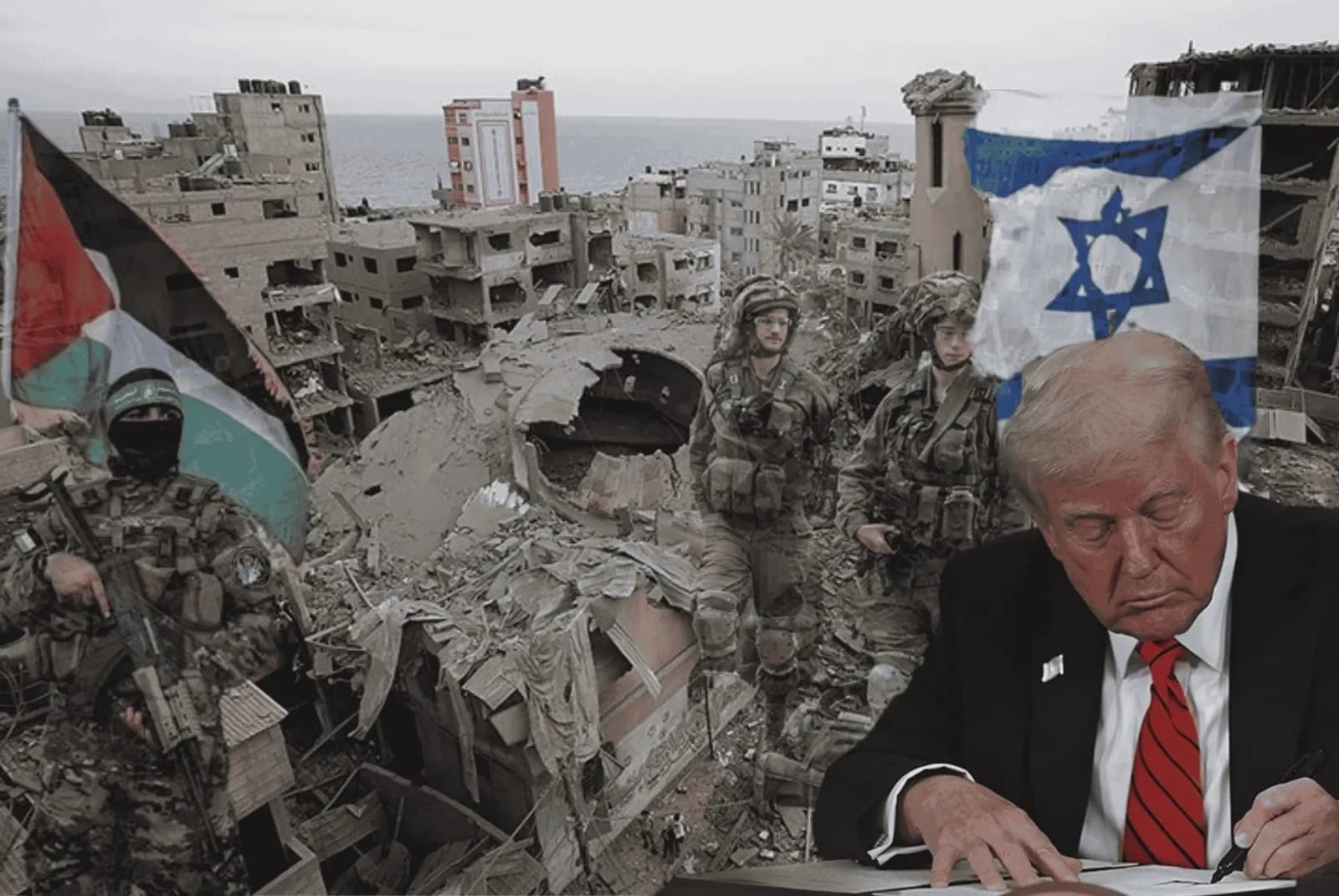
The 20-point Gaza Peace Plan announced by US President Trump on 29 September contains highly critical provisions for Gaza such as a Ceasefire and Cessation of Attacks, the Release of Hostages and Detainees, Israel’s Phased Withdrawal from Gaza, Interim Administration, International Oversight, Disarmament, Security Guarantees, Humanitarian…
THE APPROACH OF ISRAEL AND HAMAS TO TRUMP’S PEACE PLAN
The 20-point Gaza Peace Plan announced by US President Trump on 29 September contains highly critical provisions for Gaza such as a Ceasefire and Cessation of Attacks, the Release of Hostages and Detainees, Israel’s Phased Withdrawal from Gaza, Interim Administration, International Oversight, Disarmament, Security Guarantees, Humanitarian Aid, a Reconstruction Programme, the Prevention of Forced Migration and a Roadmap for Political and Administrative Transition. The positions of Hamas and Israel in particular on Trump’s Gaza Peace Plan, which both the parties and the states of the region have accepted in principle, are gaining importance.
Immediate Ceasefire / Cessation of Hostilities
- Content and Timeline: Hostilities will end immediately once the parties accept the agreement. All military operations will be suspended and front lines will remain “frozen”.
- Hamas – Acceptance: Accepted the principle of a ceasefire and the cessation of hostilities.
- Hamas – Reservations / Conditions: Clarity on the start time, the definition of violations and the monitoring mechanisms. Humanitarian aid to begin at the same time. The release of hostages to begin together with a full ceasefire.
- Israel – Partial acceptance: Trump called on Israel to stop the bombing; in response, the Israeli government announced that it had partially suspended operations “to prepare for the first phase of implementation”. The Israeli side states that the ceasefire will be coordinated with the return of hostages and security steps.
- Israel – Reservations / Conditions: Phased implementation; the right to a military response to violations and the preservation of security zones.
Return of Hostages / Prisoners
- Content and Timeline: The release of hostages is envisaged within 72 hours of the acceptance of the agreement
- Hamas – Acceptance: Accepted in principle the return of all hostages (living/dead).
- Hamas – Reservations / Conditions: While accepting in principle, Hamas draws attention to the realities on the ground. In particular, it states that reaching the bodies of hostages who were killed is not easy. It also demands that the 72-hour period begin to run with the start of an actual ceasefire, that the handover areas be secured under the supervision of international observers and mediating countries, and that Palestinian detainees be released simultaneously. Negotiations are continuing in Egypt.
- Israel – Partial acceptance: Demands the return of the hostages within 72 hours as a precondition.
- Israel – Reservations / Conditions: The Israeli side requires that the releases be swift and without preconditions and that no demonstrations or ceremonies be held; the release process is to be verified by international observers, while the return of Palestinian detainees will be considered only within the framework of the principles of “reciprocity and posing no security risk”. Israel also seeks to reserve the right to military intervention if the safety of the hostages is not guaranteed during the handover.
Israel’s Withdrawal from Gaza
- Content and Timeline: Within the framework of Trump’s 2025 Gaza Peace Plan, Israel’s withdrawal is defined as a four-phase process lasting approximately ninety days. Phase 1 envisages that, within the first seven days after the plan enters into force, the Israeli army will halt active offensive operations and pull its units back to the level of an “observation line”. In phase 2 (weeks 2–4), Israeli forces will withdraw gradually from the northern and central areas of Gaza, accompanied by the International Stabilisation Force (ISF); the progress of this phase will depend on the release of the hostages and on the ceasefire not being violated. In phase 3 (months 1–2), “supervised security corridors” will be established throughout Gaza, and the Israeli army will maintain only a symbolic presence around the Erez and Kerem Shalom crossings. In the final phase (at the end of approximately day 90), all Israeli ground elements will withdraw completely from Gaza, and responsibility for security and border surveillance will be handed over to the Palestinian technocratic interim administration.
- Hamas – Acceptance: Supports the principle of full withdrawal. Hamas officials oppose the legitimisation of the Israeli occupation on grounds of security in Gaza or any other grounds.
- Hamas – Reservations / Conditions: ‘Security corridors’, a staged and phased withdrawal, permanent checkpoints and the continuation of the occupation in limited areas are rejected.
- Israel – Partial acceptance: A gradual withdrawal is envisaged as security guarantees and the international stabilisation force come into operation.
- Israel – Reservations / Conditions: Demands the continuation of the occupation of Gaza until border security and a ‘Hamas-free’ status are secured. Opposes tying the withdrawal to a timetable.
Administration / Interim Authority / Technocratic Structure
- Content and Timeline: Under Trump’s 2025 Gaza Peace Plan, the Interim Administration (Technocratic Interim Authority – TIA) will be established within approximately six to eight weeks of the plan’s entry into force. This administration will begin operating once the second phase of Israel’s gradual withdrawal (weeks 2–4) has been completed and the northern areas of Gaza have passed under the control of the International Stabilisation Force (ISF). The task of the interim administration is to coordinate civil administration, public services and reconstruction programmes in Gaza, and at the same time to establish interim authority under an executive council made up of Palestinian technocrats, representatives of international organisations and Arab League observers. Under the diplomatic annex to the plan, this structure is defined as the first step towards a transition to full civil administration, and it is envisaged that it will assume all powers by the end of day 90 at the latest, that is, simultaneously with Israel’s full withdrawal.
- Hamas – Acceptance: A statement issued by Hamas supports the transfer of the administration of Gaza to an independent, technocratic Palestinian body.
- Hamas – Reservations / Conditions: International oversight and the powers of the board, as well as local legitimacy and appointment procedures, are subject to negotiation.
- Israel – Partial acceptance: The ending of Hamas’s administrative role and the empowerment of the interim administration have been accepted.
- Israel – Reservations / Conditions: Although Israel accepts it in principle, it has raised serious reservations concerning the limits of the powers of this structure and security oversight. The Netanyahu government announced that it supports the plan’s “return of Gaza to civil administration”, but made it a condition that this administration operate only as a civil structure under international oversight with limited security powers. Israel proposes that the Interim Administration not be directly attached to the Palestinian Authority (based in Ramallah), but instead be supervised by an oversight board to be formed by the US, Egypt, Qatar and the European Union. The Tel Aviv administration stresses that this authority must have no organic or personnel-based link whatsoever with Hamas, and states that otherwise the plan cannot be implemented.
Disarmament / Demilitarisation
- Content and Timeline: Trump’s plan aims at disarmament (the destruction of heavy weapons and tunnels; the dismantling of military capacity), but contains no fixed timetable.
- Hamas – Acceptance: The scope and method are open to negotiation; there are debates on unconditional disarmament.
- Hamas – Reservations / Conditions: A serious issue; according to statements made on the matter, weapons will be handed over only to a Palestinian State to be established in the future. The handover of heavy weapons, the destruction of tunnels and which actor will hold monitoring powers remain unclear. These are among the foremost subjects of debate.
- Israel – Partial acceptance: The aim is the dismantling of military structures in Gaza, the handover of heavy weapons and the dismantling of the armed structures of Hamas and other organisations, permitting only light weapons for internal security.
- Israel – Reservations / Conditions: Demands a monitoring regime, sanctions for violations and permanent security guarantees.
Humanitarian Aid, Infrastructure and Reconstruction
- Content and Timeline: Humanitarian aid will begin to flow immediately once the plan is accepted; but permanent reconstruction of infrastructure will cover a long period, depending on conditions of security, oversight and financing.
- Hamas – Acceptance: Hamas accepts that humanitarian aid should begin immediately and without interruption upon acceptance of the agreement.
- Hamas – Reservations / Conditions: Logistics to be run by civilian/international institutions; objects to strict monitoring mechanisms.
- Israel – Partial acceptance: An internationally supervised aid and reconstruction process has been accepted.
- Israel – Reservations / Conditions: Has announced that strict controls on dual-use materials and supervised entry and exit procedures will be applied.
No Forced Displacement
- Content and Timeline: Acceptance of the principle of no forced migration, and protection of the right of return of those who leave voluntarily
- Hamas – Acceptance: Forced displacement is firmly opposed; the right of return is emphasised.
- Hamas – Reservations / Conditions: A guarantee is sought that ‘temporary evacuations’ will not become permanent.
- Israel – Partial acceptance: A framework not based on mass forced evacuation has been accepted.
- Israel – Reservations / Conditions: Temporary evacuations and safe zones may be established on operational grounds.
Transition Roadmap
- Content and Timeline: Trump envisages, first of all, the establishment of a temporary technocratic administration for Gaza to be overseen by an international supervisory body (the “Board of Peace”); this interim administration will be responsible for the day-to-day administration of Gaza, the provision of public services and the establishment of the framework for reconstruction funds. While the Interim Administration carries out its task, the reform programme of the Palestinian Authority (PA) will be completed and, once these reforms have been implemented successfully, the PA will be enabled to take Gaza back over through a “credible transition”.
- Hamas – Acceptance: Hamas is calling for this provision to be negotiated and to be defined in clear terms.
- Hamas – Reservations / Conditions: Criticism is directed at the fact that the text refers to the aspiration of the Palestinian people rather than directly to an independent Palestinian State, at that expression not being binding, and at the uncertainty of the timetable.
- Israel – Partial acceptance: Does not accept the inclusion in the text of concepts such as an independent Palestinian State.
- Israel – Reservations / Conditions: Maintains that security is the priority issue.
How to cite
SESA Institute. (2025). The Trump Peace Plan and the Parties’ Approaches (Analysis). https://sesa.org.tr/en/publications/the-trump-peace-plan-and-the-parties-approaches
Related publications
Report
Congress and the 2026 Midterm Elections in the US: The President’s Limits under Divided Government
Prof. Cafer Tayyar Arı