Peace in the Shadow of the Gun: The Israel–Türkiye Confrontation and the Paths to Sovereignty in Syria
5 min read
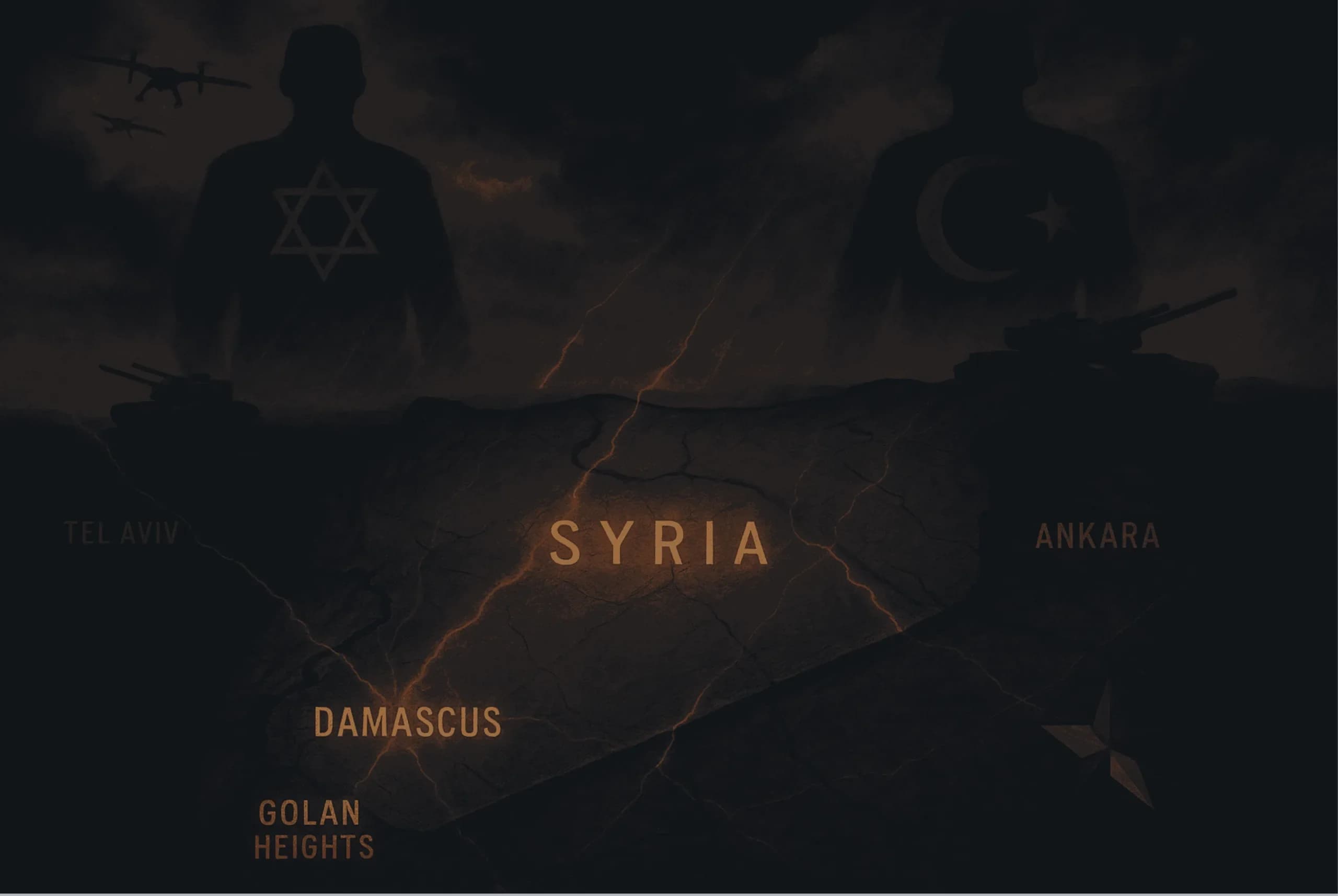
Syria is today witnessing Israeli air strikes increasing on an unprecedented scale. The most striking of these attacks was the targeting of the area around the People’s Palace in Damascus. This extraordinary development carries political and strategic meanings that go beyond the conventional military framework…
Syria is today witnessing Israeli air strikes increasing on an unprecedented scale. The most striking of these attacks was the targeting of the area around the People’s Palace in Damascus. This extraordinary development carries political and strategic meanings that go beyond the conventional military framework. With this development, Israel is revealing that it is seeking to reshape Syria’s sovereign decisions; this systematic military escalation, conducted under the claim of protecting the Druze community in southern Syria, in reality aims to secure acceptance of the de facto annexation of the Golan Heights and to exclude Syria from the regional equation between Israel and the axis of resistance.
This military escalation is advancing simultaneously with an undeclared struggle for influence between Israel and Türkiye on the ground. Although the parties have different objectives and agendas, their activities on Syrian territory come into contact with each other. While Türkiye maintains its military presence in northern Syria on the grounds of border security and combating Kurdish-origin threats, Israel is increasing its strategic influence in the south and using the Druze card as an instrument of both political and military pressure. This situation brings the following fundamental question back onto the agenda: has Syria turned into an arena of regional struggle for influence in which Israel is trying to establish dominance by military and political means? And how sustainable is this Israeli initiative in the face of the unsettling presence of Ankara, which maintains an effective position on the ground?
Syrian President Ahmed al-Sharaa, who took office in 2024, faces not only internal divisions but also mounting external pressure. Shaped around concepts such as “peace” and “stability”, this pressure is in fact aimed at weakening Syria’s historic national principles and imposing an externally sourced model of solution. In this process, direct and open threats against President al-Sharaa have also come onto the agenda. These should be read as part of a strategic pressure aimed at making Damascus concede on fundamental questions of sovereignty, particularly the Golan file.
To understand these developments in depth, it is necessary to recall the historical context of the Golan question. Israel has retained the Golan Heights, which it occupied in the June 1967 War, despite the disengagement agreement signed in 1974. That agreement secured a ceasefire but did not produce a final settlement. When Israel announced in 1981 that it had formally annexed the Golan, the United Nations Security Council declared the annexation null and void in Resolution 497. The negotiations conducted through US mediation in the 1990s failed because of Syria’s insistence on full withdrawal to the borders of 4 June 1967. In 2019, US President Donald Trump unilaterally recognised Israel’s sovereignty over the Golan, a step rejected by the UN and world public opinion.
Resting on this historical background, Israel’s strategy is today shaped by a logic of “submission in return for peace”. Israel aims to establish a new military and political balance by exploiting regional fragilities and the political, economic and social fragmentation within Syria. In this framework, the exploitation of the US-backed Druze and Kurdish files carries the risk of weakening the position of the central government by creating new divisions within Syria.
At this point, a number of burning questions arise: is the recent ceasefire in Suwayda, secured with Israel’s encouragement, a manoeuvre to force the Damascus administration into conditional negotiations and to make it renounce the Golan? Does Israel want to draw Türkiye into a direct confrontation? Or is Tel Aviv, by spreading this process over time, building step by step on the ground a new political order that suits its own interests?
Although Türkiye maintains a limited military presence in the north, it does not appear willing to enter into a direct confrontation with Israel. It is nevertheless playing an active role in the Syria file by conducting diplomatic contacts with the US. This disturbs Israel, because Ankara still holds decisive power at certain strategic decision points in Syria and prevents Tel Aviv from controlling the Syrian arena on its own.
The failure of the US to intervene as a deterrent against Israeli attacks risks further deepening the fragile structure within Syria. In particular, the receipt of direct support from Washington and Tel Aviv by certain factions of Druze and Kurdish groups could lead to the exclusion of the central structure and to the new political order established with local actors being determined by Israel. In this context, the integration of the SDF and certain Druze elements into a new political structure poses a serious threat to Syria’s national integrity.
All these developments bring onto the agenda Iran’s re-emergence as an effective actor in Syria. Tehran will try to counterbalance Israel’s regional plans either through direct military support or through allied forces in Lebanon and Iraq. The positions of the Arab countries in this equation also vary. While some states are moving towards normalisation with Israel, others accept no solution in which the Golan does not return to Syria. This reflects a serious divergence in the Arab world over the Syria file.
In conclusion, Israel’s strategy rests not on a peace based on international law but on a model of imposition shaped by military force. Türkiye, for its part, prioritising its own security concerns, is protecting its influence on the ground by both military and diplomatic means and trying to prevent Israel’s absolute dominance.
The fundamental challenge facing Syria is the necessity, under the leadership of President Ahmed al-Sharaa, of preserving its sovereignty without turning to the path of direct war. Thirteen years of civil war make it almost impossible for the country to enter into another conflict. The priority is therefore reconstruction and the achievement of social stability.
In its recent statements, the Syrian administration has sent Israel an indirect message by declaring that it poses no threat to its neighbours. Israel, however, is pursuing its plans for strategic expansion and aims to redraw the map of Syria. In this context, should the current situation persist, the Damascus administration may be compelled to turn to models of regional accommodation such as the “Abraham Accords”. Such a step could be regarded as a pragmatic choice for preventing a direct war and protecting internal security. For the regional equation is now being rewritten not through negotiation but through the balance of power on the ground.
Author

How to cite
Sağlam, G. Y. (2025). Peace in the Shadow of the Gun: The Israel–Türkiye Confrontation and the Paths to Sovereignty in Syria (Analysis). SESA Institute. https://sesa.org.tr/en/publications/peace-in-the-shadow-of-the-gun-the-israel-turkiye-confrontation-and-the-paths-to-sovereignty-in-syria