Two Days in Damascus: The Pulse of Life in the Shadow of War
11 min read
When the Umayyads of Damascus fell, Abd al-Rahman of the dynasty made his way, in an adventure worthy of the cinema, from Damascus to the Maghreb and from there by ship to al-Andalus, then divided among various tribes and powers. There he re-established the Umayyad state of al-Andalus, enabling the Umayyads to survive for several more centuries…
Two Days in Damascus: The Pulse of Life in the Shadow of War
When the Umayyads of Damascus fell, Abd al-Rahman of the dynasty made his way, in an adventure worthy of the cinema, from Damascus to the Maghreb and from there by ship to al-Andalus, then divided among various tribes and powers. There he re-established the Umayyad state of al-Andalus, enabling the Umayyads to survive for several more centuries.
Yet for as long as he lived, Abd al-Rahman carried Damascus within him like an ember that never went out. His longing for Damascus lived on as a deep yearning that gnawed at him from within. When those around him said, “Look, al-Andalus too resembles Damascus, with its buildings, its gardens and its streets,” Sultan Abd al-Rahman would repeat words to the effect of: “Yes, it resembles it; but Damascus is different. It only resembles it; nowhere can take the place of Damascus.”
أيها الراكب الميمم أرضي
أقرئ من بعضي السلام لبعضي
إن جسمي كما علمت بأرضٍ
وفؤادي ومالكية بأرضِ
“O traveller bound for my homeland!
Carry my greeting, a part of me, to another part of me.
My body, as you know, is in distant lands;
but my heart and my beloved are in Damascus.”
Abd al-Rahman al-Dakhil (founder of the Umayyad state of al-Andalus)
The Visit to Damascus
We were in Damascus on 9–10 August 2026. Rather than an ordinary travel programme, this visit was an opportunity to see at first hand life after the war in the Syrian capital, what has changed and what has not. Over two days we met people from different circles; we spoke with bureaucrats, business people and students. We wandered the historic streets of Damascus, toured its bazaars and listened to its people. In a sense, we wanted not merely to see the city but to try to understand it anew.
I had been to Damascus before, in 2009. The years that have passed since then brought one of the most terrible periods in Syria’s history. The war changed the lives of millions of people; cities were destroyed and people were displaced. That is why one of the first things I noticed when I set foot in Damascus again was that in some parts of the city time seemed almost to have stood still.
Despite the full weight of the war, Damascus had not suffered destruction on the scale seen in other cities of the country. For this reason, many of the things I had seen in 2009 were still in place. The streets, the historic buildings, the bazaars and the general fabric of the city were familiar. When people return to a city after many years, they sometimes look for its past; in Damascus, however, the past was not only remembered but continued to live before your eyes.
Hopes Beginning to Blossom in Damascus
On the first day of our visit to Damascus, we met business people who had voluntarily returned to their country from various countries. Some of those we spoke with had returned from Europe, others from the Gulf countries. What they had in common was a wish to take on responsibility in Syria’s reconstruction process. Yet not long ago, only a few years earlier, many of these people had been forced to risk extremely dangerous routes in order to reach Europe or the Gulf countries. Today, the wish of the same people to return to their country with their knowledge, experience and capital and to contribute to Syria’s future was one of the most striking signs of the change beginning to take root on the ground.
In the second part of our programme we visited the TİKA Damascus Office. We had the opportunity to hear at first hand about the work TİKA is carrying out in different regions of Syria and its activities that touch people’s lives directly. Through this meeting we gained comprehensive information not only about the projects implemented but also about living conditions in Syria’s rural areas, people’s basic needs and the difficulties they face. These contacts were extremely important in enabling us to assess more accurately the current conditions in the country and the opportunities that may arise in the coming period.
Later in the day we had the opportunity to walk the streets of Damascus and observe at close quarters a life that is gradually returning to normal. Seeing everyday life in the city beginning to find its own rhythm again allowed us to consider the information obtained in our official meetings together with our observations on the ground.
We then held an extremely comprehensive and productive meeting, lasting about an hour, with the Ambassador of the Republic of Türkiye in Damascus. The assessments we made at the Embassy were particularly valuable in helping us to understand more closely the developments in Syria, the balances on the ground and the possible opportunities ahead for Türkiye–Syria relations.
We then met an official serving in a Syrian ministry. In this way, in the course of a single day, we had the opportunity to make contact with different circles ranging from the business world to diplomacy and from the bureaucracy to the field of humanitarian development, and to assess Syria’s current situation from different perspectives.
One of the most interesting and instructive meetings of the day took place late at night. We had a warm conversation lasting about three hours with a Syrian businessman from the Damascus countryside and his son. Father and son conduct their business in Saudi Arabia but come to Syria regularly. In the course of our long conversation we talked not only about the economy and trade but also about Syria’s future, the expectations of society, the change under way and the opportunities ahead in the reconstruction process.
What struck me most in these meetings was that, despite all the economic and social difficulties in the country, people’s hopes for the future were once again making themselves strongly felt. Syria undoubtedly has a long and difficult road ahead. But the presence of people who are returning to their country, who wish to invest and who are preparing to take on responsibility in the reconstruction process strengthens optimism about the future.
In Damascus, no significant change can yet be observed in reconstruction. But the signs of a new era are clearly visible in people’s thinking, in their expectations and in the bonds they are forming anew with their country. Sometimes hope shows itself, before any grand announcements, in people’s decision to return to their country, in the courage to invest again and in the will to build the future together. That is exactly what we witnessed in Damascus: a hope beginning to blossom again despite every difficulty.
From the Umayyad Mosque to the Hamidiyeh Bazaar
The next day we gave ourselves over to the historic centre of Damascus.
Seeing the Umayyad Mosque again was, for me, also like going back to 2009. We then wandered through the Hamidiyeh Bazaar. The bustle of the bazaar, the shops, the people and the distinctive rhythm of the streets showed that Damascus is still a living city.
As we walked the historic streets around the Hamidiyeh Bazaar, we encountered another face of the city. Damascus was not merely a collection of historic monuments. Among the old stone buildings, the narrow streets and the historic structures, an extremely lively everyday life was going on.
The vitality of life in Damascus was perhaps one of the most striking features of the whole visit. The streets were busy even late in the day. Although nightlife in the city differs from what we are used to in Türkiye, one could sense people being out and about, chatting, shopping, and life continuing until morning.
Behind this vitality, however, lay severe economic problems.
Unemployment was at its peak. The traffic was utter chaos. Economic conditions were making people’s lives seriously difficult. Even so, it would not be possible to say that pessimism prevailed among all the people we saw in the street. On the contrary, many people had hope for the future of their country.
Perhaps this was the most striking thing about Damascus: life going on in the midst of great hardship.
The real story of a city lies in its people
The best way to understand a city is not only to look at its historic monuments but to talk to its people.
At the end of our visit we experienced a fine example of this.
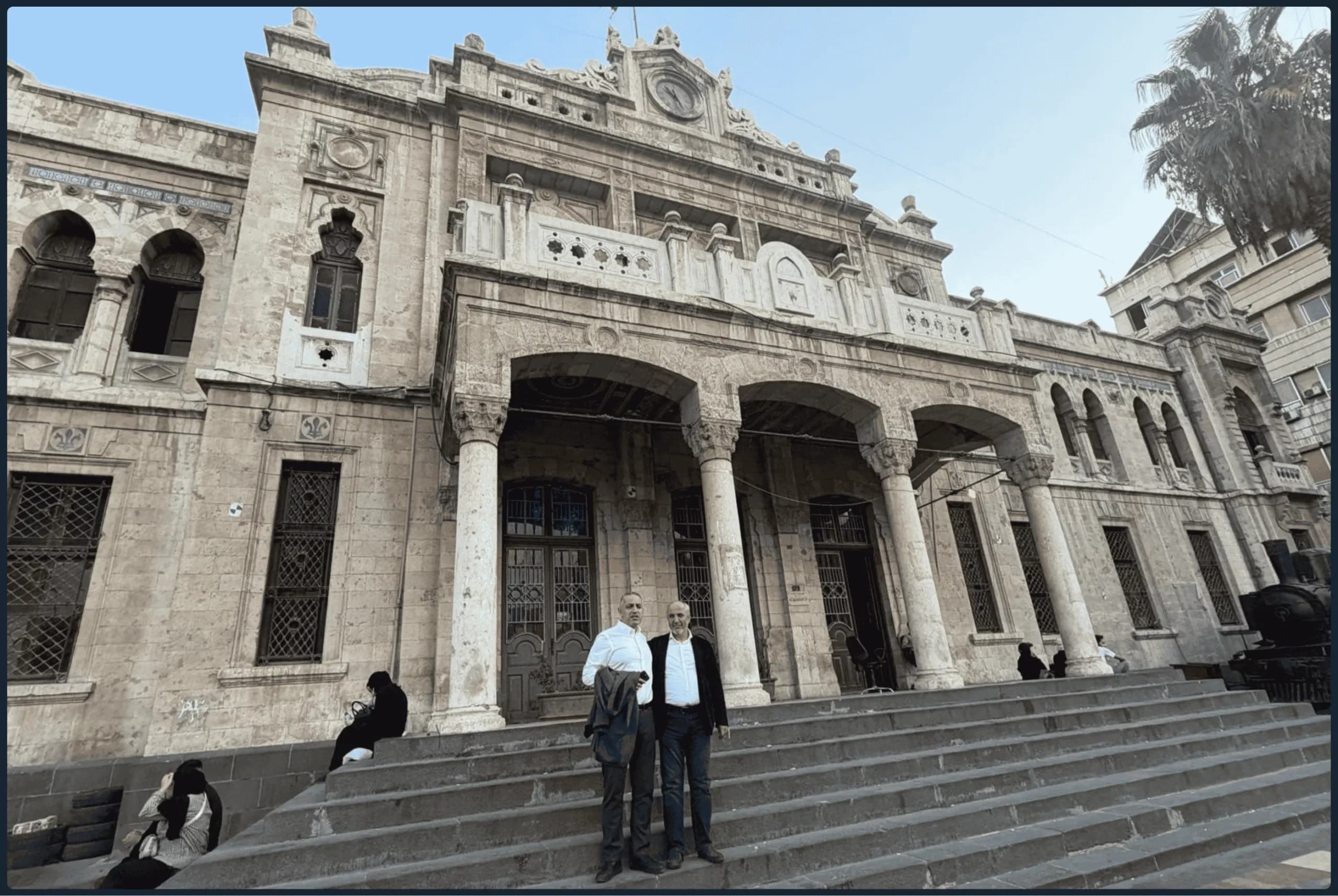
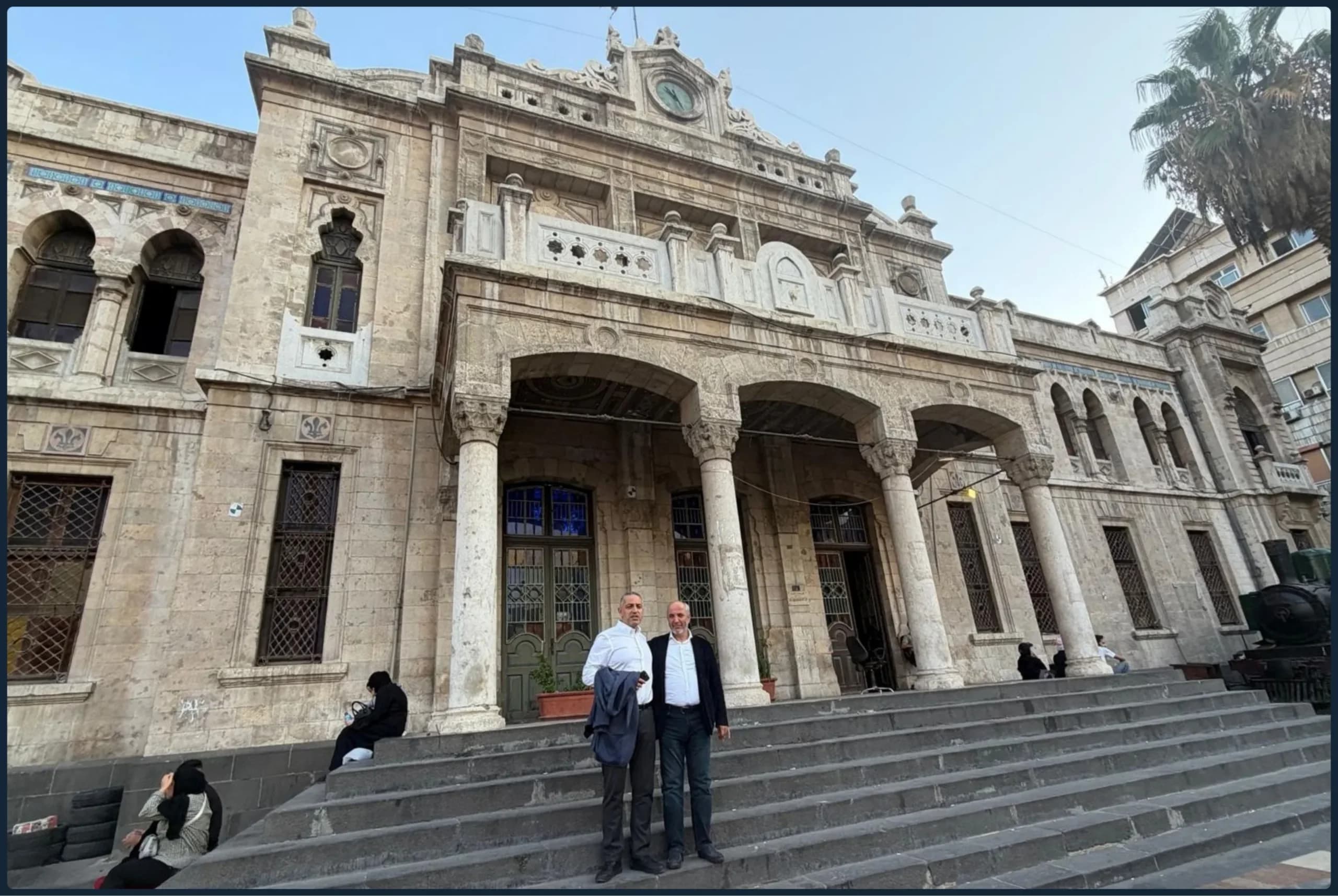
We sat for a while on the steps in front of the Hejaz Railway Station. There we met two university students. Both were from Qamishli and were studying at Damascus University. We had a deep conversation with the young people. This conversation with two young university students, sitting in the centre of Damascus in front of the historic Hejaz Railway Station, was perhaps one of the most meaningful moments of the two-day visit.
For before us was a generation that represents the future of Syria.
What they told us, their perspectives and their expectations of the future were as important as the diplomatic meetings for understanding the transformation in the country. It is not enough to hear about a country’s future only from politicians or bureaucrats. One must also know what university students think and what kind of future young people imagine for themselves.
Over two days in Damascus we talked to different people: business people, bureaucrats, diplomats and students… Each of them had a different story to tell about Syria. But what they all had in common was the effort to rebuild life despite difficult conditions.
Damascus from 2009 to 2026
When I came to Damascus in 2009, the city was the capital of a different country. The war had not yet happened, millions of people had not been displaced, and the country’s future had not become as uncertain as it is today.
When I came again in 2026, there was a different mood in the same streets.
Physically, the city was in some places surprisingly familiar. But the traces of the war were in people’s memories. Economic problems, unemployment and uncertainty had become significant parts of daily life.
Nevertheless, what caught one’s attention in Damascus was not only poverty or problems. It was people’s desire to build a normal life.
The bazaars were open. The restaurants were full. People were in the streets. Young people were going to university, business people were trying to trade, bureaucrats were working on the country’s future, diplomats were continuing their contacts, and historic Damascus went on living in the midst of it all.
Perhaps this is the first sign of cities rising again after wars: people beginning to build lives once more.
Leaving Damascus
At the end of the two days, as we headed for the airport, one of the images that stayed with me most was of those two young people sitting on the steps in front of the Hejaz Railway Station.
In the historic centre of Damascus, in front of a century-old railway station, we had talked with two university students who had come from Qamishli, a different corner of Syria.
On one side, historic Damascus, standing with all the weight of the past; on the other, young people searching for their future…
Perhaps the story of Syria lies precisely between these two images.
Damascus is not a city whose problems have all been solved. Unemployment is high, economic conditions are harsh, the traffic is chaotic and the uncertainties about the future are still great. But the city goes on living.
People are in the streets.
The bazaars are open.
The restaurants are full.
Young people talk about the future.
And Damascus, despite everything that has happened, lights up again at night.
Much had changed between the Damascus I left in 2009 and the Damascus I encountered again in 2026. But one thing had not changed:
Damascus was still alive.
As we made our way to the airport, what we left behind was not merely a two-day trip. It was also a brief glimpse of a society trying to rebuild its life after the war.
Damascus reminded us once again that history does not live only in stone buildings and old mosques.
History also lives on in the faces of the people walking in the street, in the voices of the shopkeepers in the bazaar, in the calculations of business people about the future and in the hopes of two young students talking about their future in front of the Hejaz Station.
Once again Damascus is waking from where it fell into a dream. Perhaps lost in a reverie of returning to the splendour of the era of Muawiya…
Author
Samir Altunkaynak
Director of Law and Justice
How to cite
Altunkaynak, S. (2026). Two Days in Damascus: The Pulse of Life in the Shadow of War (Analysis). SESA Institute. https://sesa.org.tr/en/publications/two-days-in-damascus-the-pulse-of-life-in-the-shadow-of-war
Related publications
Report
2026 Knesset Election: A Victory for the Radical Right Electorate in Israel?
Prof. Veysel Ayhan